
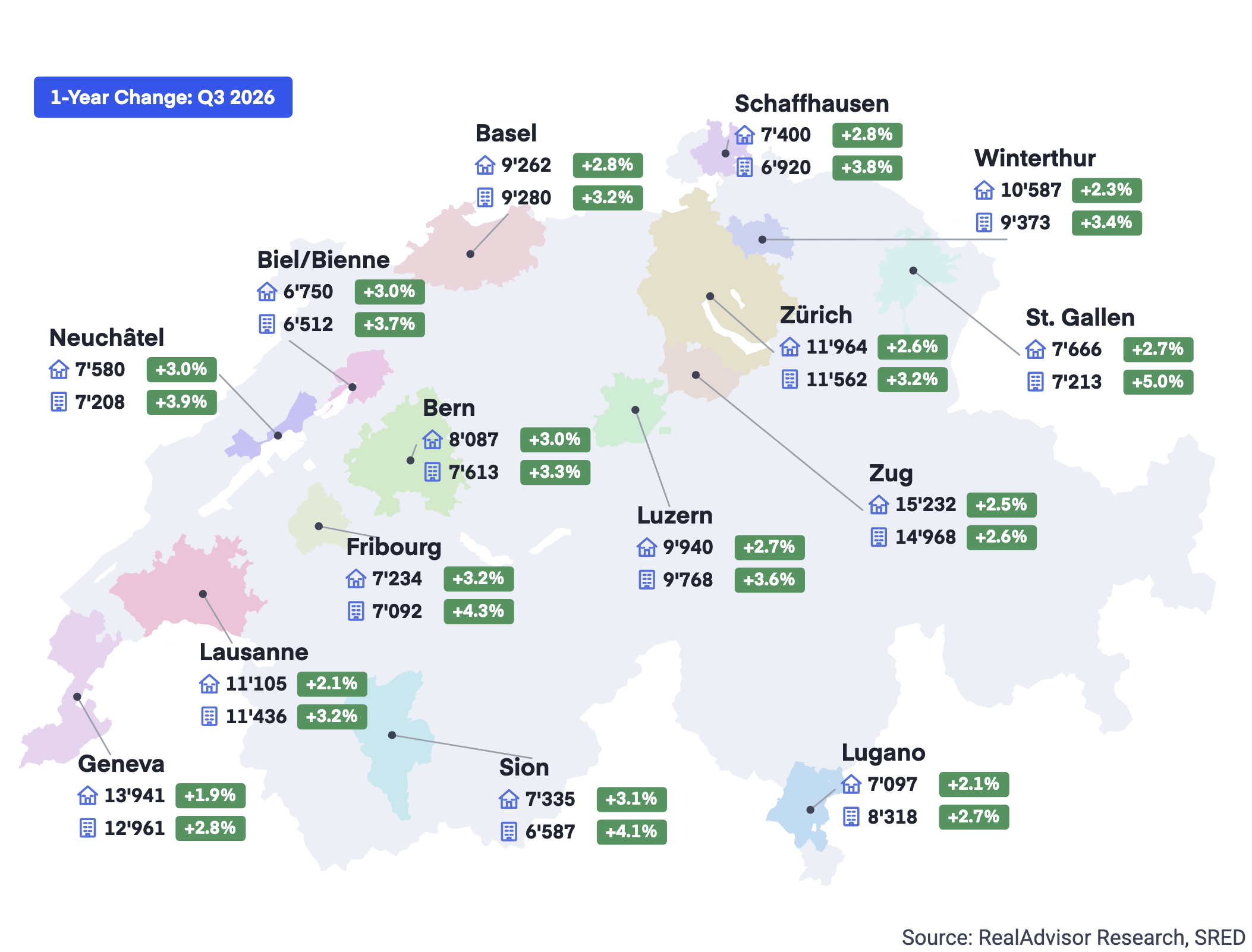
Annual change in real estate prices as of 30 September 2026
Average price per m² of houses and apartments
Q3 2026: 1-year price changes in 15 major urban areas
Momentum Shifts to the More Affordable Cities
Apartment prices rose +1.0% in the third quarter and +3.4% over twelve months, ahead of single-family homes (+0.8% and +2.9%). All fifteen urban areas and all twenty-six cantons are up on the year, but the momentum has shifted. For a decade Zug and Zürich set the pace; over the past twelve months the fastest apartment growth came from more affordable cities: St. Gallen (+5.0%), Fribourg (+4.3%) and Sion (+4.1%). Lugano (+2.7%) and Zug (+2.6%) bring up the rear.
Methodology note: our Swiss price model was recalibrated this quarter. Price levels are not comparable with those published in earlier editions; all Q3 2026 figures in this report are calculated on the new basis.
Growth Follows Affordability
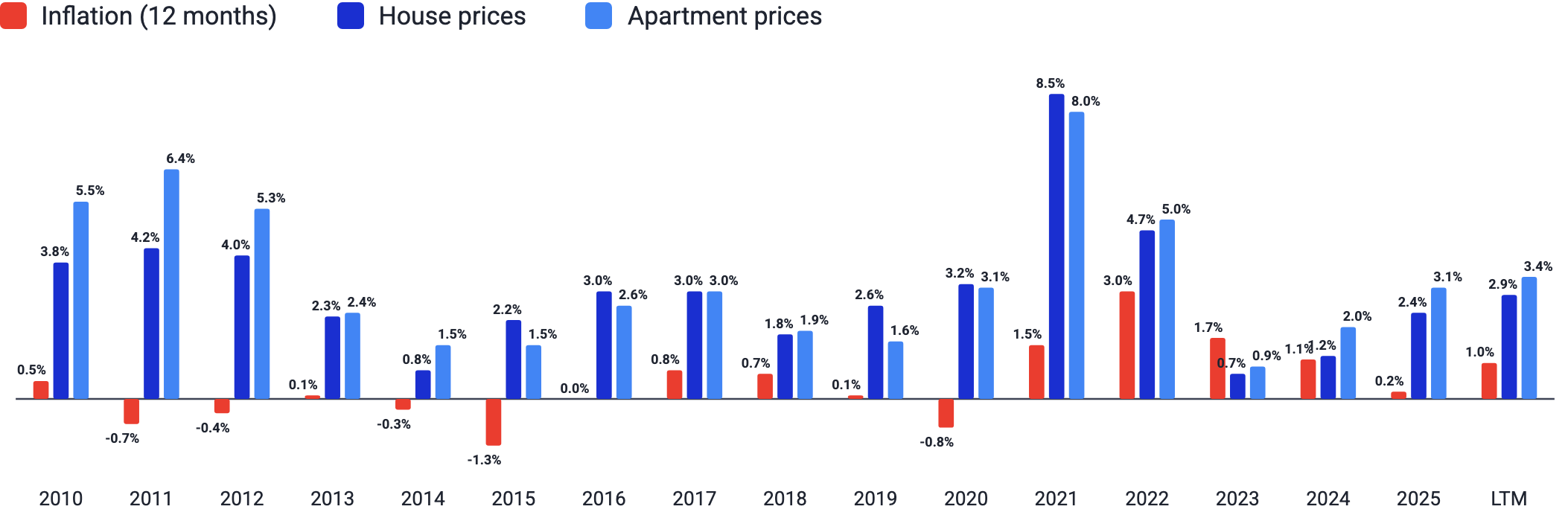
Over twelve months, apartment prices rose +3.4% and single-family homes +2.9%, well ahead of consumer prices (+1.0% in September, FSO). The longer view is starker. From 2016 to 2025 our national index rose +31%, rents +14% and nominal wages +9% (FSO): purchase prices have risen more than three times as fast as wages, rents far less. The latest twelve-month changes widen the gap into 2026 (+36%, +15%, +11%). What has changed is where the growth comes from.
The market has tilted. The five most affordable urban areas for apartments (Biel/Bienne, Sion, Schaffhausen, Fribourg, Neuchâtel, CHF 6,510 to 7,210/m²) gained +4.0% on average over twelve months; the five most expensive (Zug, Geneva, Zürich, Lausanne, Luzern) +3.1%. The gap is under one point, but it runs against the decade: over ten years the expensive centres rose +44%, led by Zug (+57.4%) and Zürich (+49.4%), the cheaper five +34%.
How much is my house worth?
Enter your address and click the button to access the RealAdvisor valuation tool.
Our reading is that the banks’ affordability test, more than taste, is doing the sorting. With prices running ahead of wages, the test binds first where prices are highest, and demand appears to follow the numbers that still work. Price is not the only driver: Bern, at CHF 7,610/m², rose +3.3%, less than the cheaper five.
Single-family homes trace the same map at a gentler pace. Fribourg (+3.2%) leads the fifteen urban areas, followed by Sion (+3.1%), then Neuchâtel, Bern and Biel/Bienne (+3.0% each). Lausanne and Lugano (+2.1% each) and Geneva (+1.9%) close the table.
Among the cantons, smaller and cheaper markets lead. Apartments rose most in Glarus (+4.9%), then Solothurn (+4.6%), Fribourg (+4.4%), St. Gallen and Appenzell Ausserrhoden (+4.3% each), houses in Glarus (+4.0%) and Solothurn (+3.5%). Several lie within commuting distance of Zürich, Bern or Basel, at a fraction of their prices.
The exception remains Ticino: +1.7% for houses over the year, the weakest of all cantons, and +13% to +15% over ten years against +34% to +37% nationally. The third quarter brought a tentative sign of life: Lugano posted the strongest house gain (+1.1%) and the joint second-strongest apartment gain (+1.2%) of the fifteen urban areas. One quarter does not make a trend.
Wages, purchase prices and rents, 2016-2026 (index 2016 = 100)
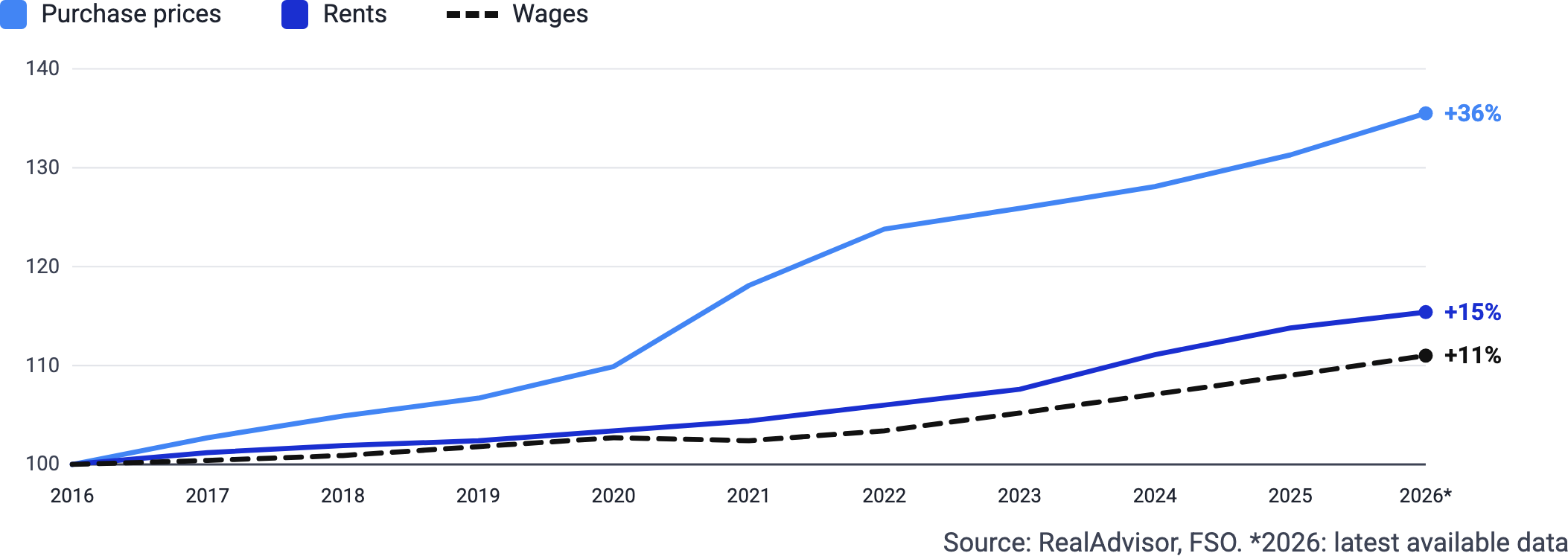
Source: RealAdvisor, FSO. *2026: latest available data
Fewer Loans, Higher Prices
Transactions are slowing again. By our estimate, about 43,000 sales over the last twelve months to September (-4%), after 45,000 in 2025 (+5%), still below the ten-year average of about 50,000. Official registries point the same way: in Geneva, 668 transactions were recorded in the second quarter, 12.8% fewer than a year earlier (OCSTAT).
Mortgage lending is not expanding. According to the broker Resolve, 22,130 new home loans (CHF 20.2 billion) were written in the second quarter: more than in the first, a seasonal effect, but 3.9% fewer than a year earlier, and 5.1% less in volume. Owner-occupied homes took 63% of the market; lending on investment properties fell 6.7% year-over-year. Prices are rising while new credit shrinks: in our reading, scarcity, not cheap money, is setting the price.
Raiffeisen reports longer marketing times and slightly fewer financed purchases. Our index does not show a slowdown yet: apartment prices rose about 1% in each of the last two quarters, faster than in 2025. We see no sign of a downturn.
On the supply side, the improvement is still on paper. Building permits have been rising again since 2024 (FOH), but completions fell to 39,638 dwellings in 2024 (-15.2%, FSO) and were flat in 2025 according to provisional figures. Given the lag from permit to handover, the extra homes should arrive in 2027-2028, and the Swiss Contractors’ Association’s construction index (Q3 2026) sees residential building staying high but easing slightly until mid-2027.
Meanwhile the stock keeps tightening: on 1 June only 0.93% of dwellings stood empty (FSO), about 45,500 units, a sixth consecutive decline and the first reading below 1% in over a decade. Zug (0.20%) and Geneva (0.31%) are close to zero. Net immigration slowed in the first half (29,900, -12.5%), which eases pressure without reversing it.
Rents are no longer a tailwind for investors: the reference rate that governs rent adjustments is stuck at 1.25% (FOH), while prices keep rising. Gross yields are being squeezed and new buy-to-let purchases rely increasingly on further price gains, a likely reason why private investors are holding back (Resolve).
Yearly transaction volume evolution, 2012 to today
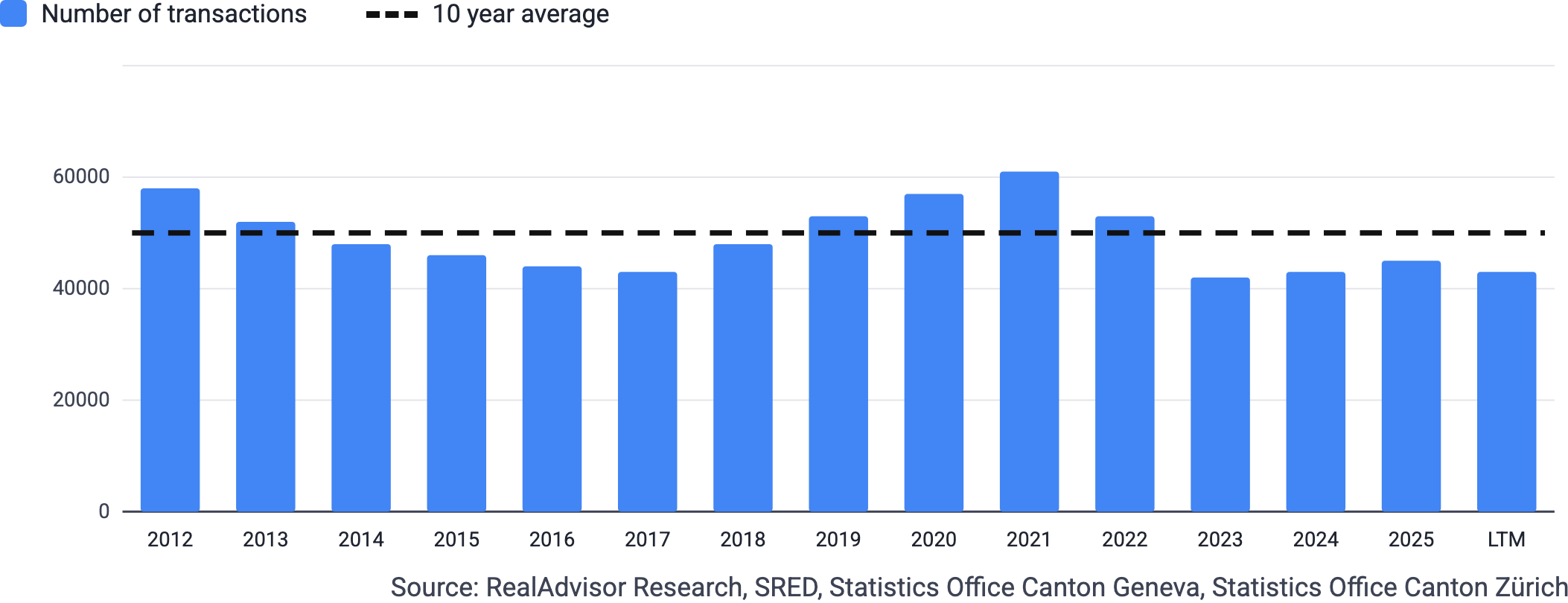
Source: RealAdvisor Research, SRED, Statistics Office Canton Geneva, Statistics Office Canton Zürich
Cheap to Own, Hard to Buy: Our Outlook
Financing is cheap: the SNB held its policy rate at zero on 24 September and the 10-year fixed rate stood at 1.77% at the end of June (Comparis), with about 42% of new contracts locked for ten years. Cheap money, however, does not close the gap between prices and wages shown in the “Wages, purchase prices and rents” chart above.
The bottleneck is access. The banks’ test prices the mortgage at an imputed 5%, almost three times today’s ten-year rate, and requires 20% equity: both hurdles grow with prices, which have outpaced wages since 2016. Many first-time buyers are at the limit: their median loan-to-value at Resolve was 79.3% in the second quarter, against a ceiling of 80%. Risk indicators are rising, not alarming: UBS lifted its bubble index to 0.72 (“moderate”).
Since 2016, buying has become dearer relative to renting: purchase prices rose more than twice as fast as rents (+31% against +14%). For households weighing the two, renting has become the relatively cheaper option, which in our view limits how far first-time demand can push prices.
Two regulatory dates matter. The imputed rental value disappears on 1 January 2029: we expect owners to bring renovations forward while upkeep is still deductible. The Lex Koller may be tightened: on 22 September the National Council backed a return to the 1985 rules; the Council of States is expected to resist, but the direction for foreign demand is restrictive.
For 2026 we now expect apartments to rise by about +3.5%, above our +2.5% to +3.0% range, and houses by about +3.0%, at its top. Buyers: the more affordable cities offer the most room under the affordability test, and long fixed rates remain cheap. Sellers: prices hold, but marketing times lengthen; ambitious asking prices cost time. Investors: with rents flat, returns depend on location and further price gains.
Evolution of real estate prices in relation to inflation since 2010
How much is my house worth?
Enter your address and click the button to access the RealAdvisor valuation tool.
Cantons: Evolution of single family home and apartment prices
Apartments
Single Family Homes
Agglomerations: Evolution of single family home and apartment prices
Apartments
Single Family Homes
Additional information
- Online Property Valuation Online
- Property prices in Switzerland
- Download the complete version of the barometer
Press contact
- press@realadvisor.com
- +41 (0) 22 552 46 46
RealAdvisor SA
Rte de Saint-Julien 198,
CH-1228 Plan-les-Ouates
RealAdvisor AG
Hönggerstrasse 65
CH-8037 Zürich

 Suisse
 España
 France
 Italia
 Belgique / België
 Česko
Česko Deutschland
 Nederland
 Österreich
 Polska
 Portugal
 United Kingdom
