
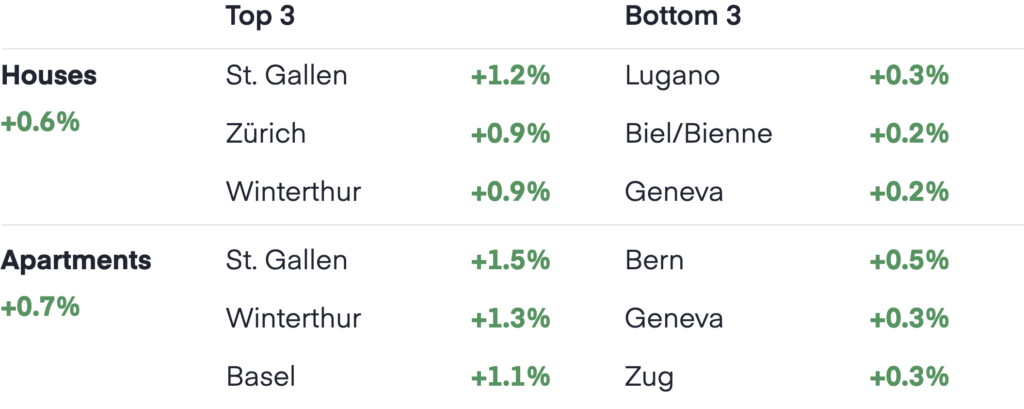
Quarterly change in real estate prices as of 30 June 2026
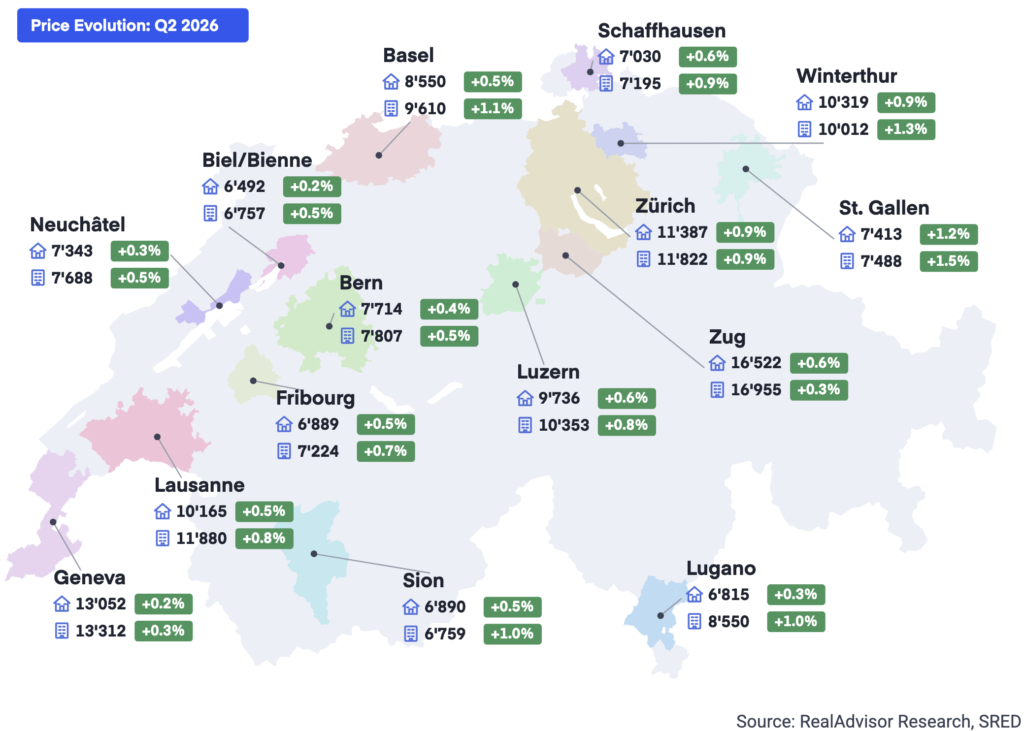
Average price per m² of houses and apartments
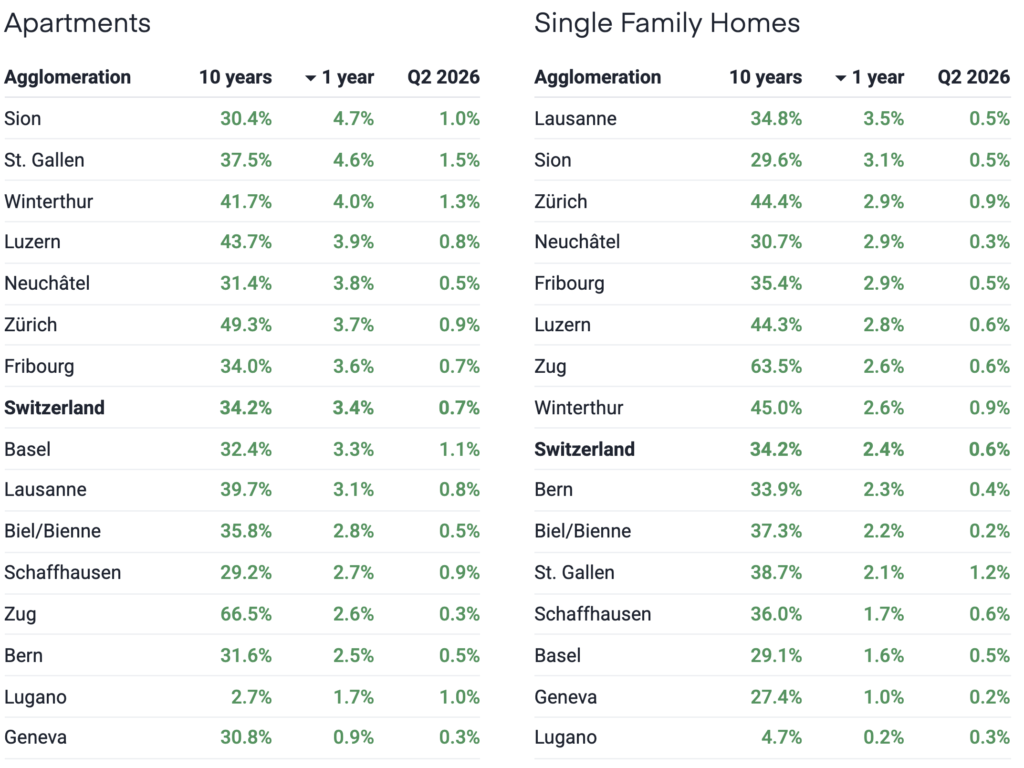
Q2 2026: Price changes in the 15 largest urban areas
Apartments Keep the Lead as the Market Stays Tight
Apartment prices rose +0.7% over the quarter and +3.4% over twelve months, again outpacing single-family homes (+0.6% and +2.4%). The growth is broad: all fifteen major urban areas are positive on the year in both segments, and so is virtually every canton — only Ticino house prices are flat. Supply remains the binding constraint: the vacancy rate sits at its lowest level since 2013 and the rebound in building permits has yet to translate into completed homes. The quarter keeps our 2026 forecast at the upper end of the +2.5% to +3.0% range.
Broad-Based Growth, Led Again by Apartments
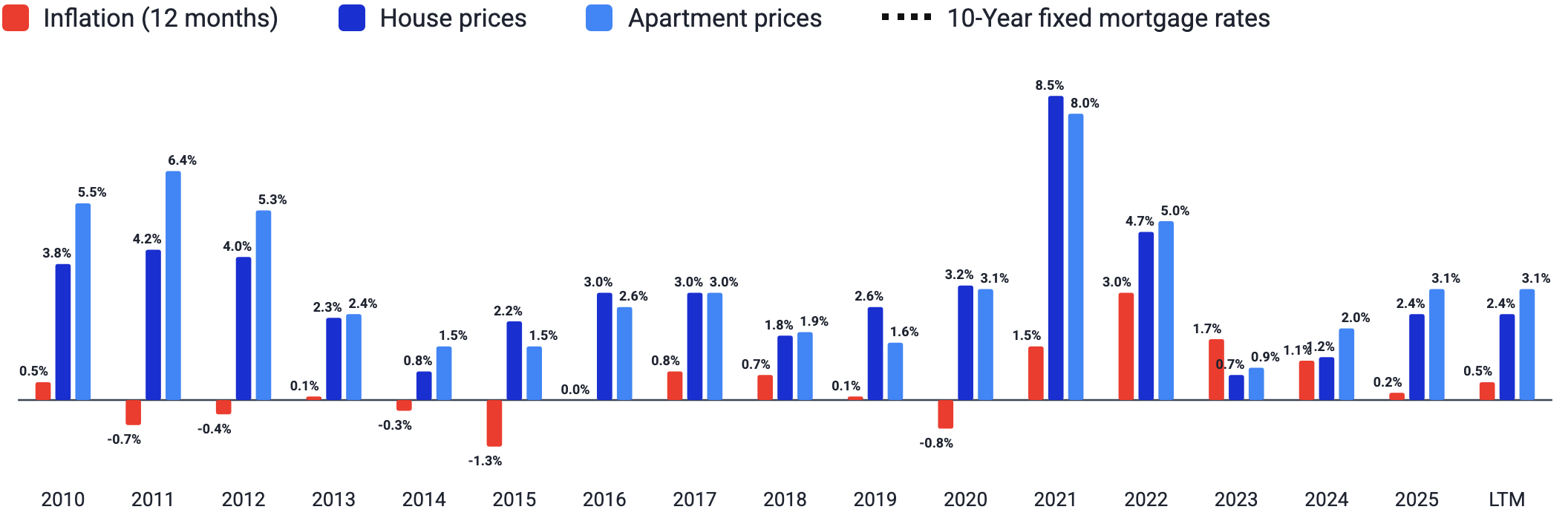
Swiss residential prices posted another positive quarter. At the national level, apartment prices rose by +0.7% quarter-over-quarter and +3.4% year-over-year. Single-family homes increased by +0.6% over the quarter and +2.4% over twelve months. With consumer prices up just 0.5% over the same period, these gains remain solid real price growth.
This extends the pattern of the past two years: apartments once again grew faster than single-family homes, and the move is broad rather than concentrated. All fifteen major urban areas gained on the year in both segments, as did nearly every canton. Over ten years the national index is up roughly +34% in both segments.
The strongest apartment markets sit outside the usual core. St. Gallen (+1.5%), Winterthur (+1.3%) and Basel (+1.1%) gained the most over the quarter, and over twelve months Sion (+4.7%), St. Gallen (+4.6%) and Winterthur (+4.0%) lead. Zürich (+3.7%) runs just above the national average, while Geneva (+0.9%) and Zug (+2.6%) grow more slowly from the country’s highest price levels.
How much is my house worth?
Enter your address and click the button to access the RealAdvisor valuation tool.
Single-family homes show the same geography at a gentler pace. Lausanne (+3.5%) and Sion (+3.1%) lead the fifteen largest urban areas, followed by Zürich, Neuchâtel and Fribourg (+2.9% each). At the bottom of the table, Geneva (+1.0%) and above all Lugano (+0.2%) lag the field.
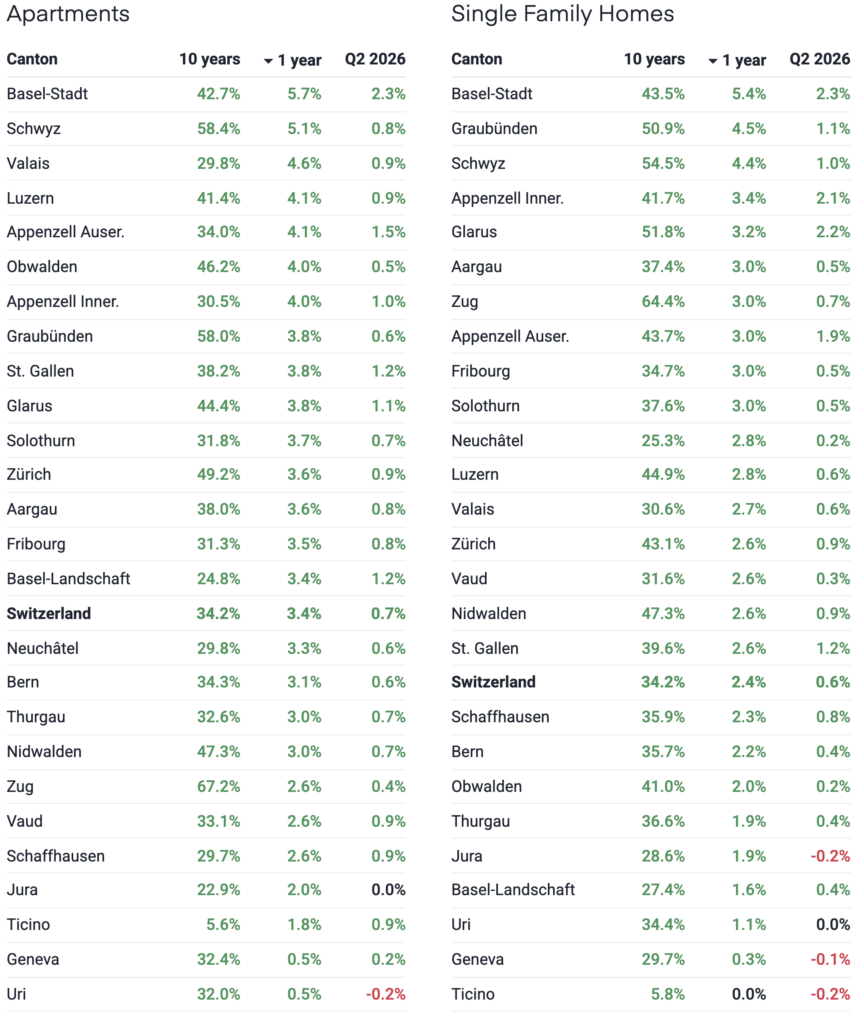
The canton data confirms the pattern at a wider lens. Apartment growth was strongest in Basel-Stadt (+5.7%), Schwyz (+5.1%) and Valais (+4.6%), with houses led by Basel-Stadt (+5.4%), Graubünden (+4.5%) and Schwyz (+4.4%). No single metropolitan market is driving the quarter.
The exception remains Ticino. Apartments in the canton rose just +1.8% over the year and house prices were flat, and the Lugano agglomeration is the softest of the fifteen largest urban areas in both segments (+1.7% and +0.2%). Over ten years Ticino has gained about +6%, against roughly +34% nationally.
Supply Improves on Paper, Not Yet on the Ground
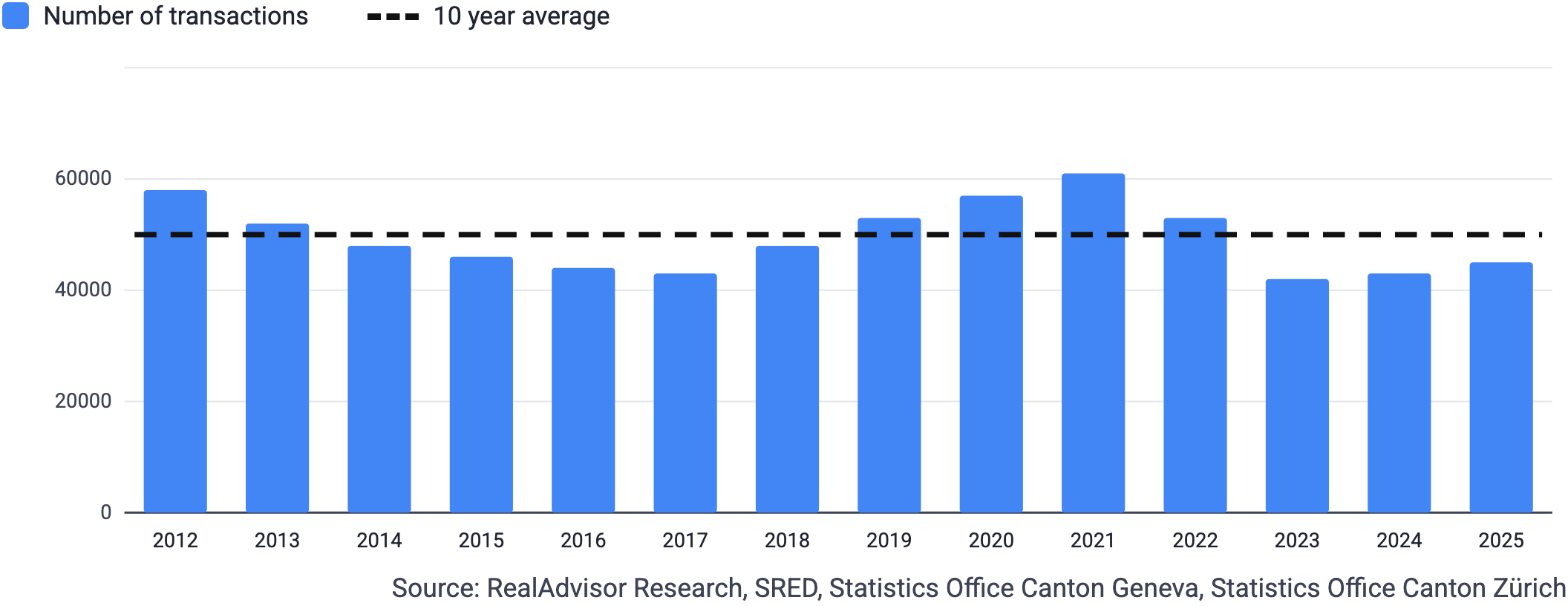
Transaction activity continues its gradual recovery. Our estimate is inferred from the Swiss Real Estate Datapool (SRED), a bank-contributed transaction pool covering roughly a third of the market, cross-checked against the cantonal registries of Zürich and Geneva. The latest reading (first quarter of 2026) shows transfers up about +3% year-over-year, and our annual series below tells the same story: after two years of sharp declines, activity stabilised at about 43,000 sales in 2024 (+2%) and reached roughly 45,000 in 2025 (+5%), still below the ten-year average of about 50,000.
The SNB’s mortgage statistics confirm the direction in the second quarter: banks wrote 22,130 new home loans (CHF 20.2 billion), up +5.0% on the first quarter, with the owner-occupied segment growing +12.1% and taking 63% of the market while investor demand retreated. Across 2025 as a whole, new mortgage lending grew +6.3% by count.
Prices are rising while turnover remains below its ten-year average: scarcity, not excess liquidity, is setting the price. The supply side is improving on paper. Newly authorised dwellings rebounded to more than 52,000 in 2025, up from roughly 41,000 in 2023. But completions actually fell in 2024 (about 40,750 units, -12.8% according to Wüest Partner), and the lag from approval to handover means the extra supply lands in 2027-2028 rather than this year.
The vacancy statistics tell the real story: 1.00% of the housing stock stood empty on the last count, some 48,500 dwellings, a fifth consecutive annual decline and the lowest reading since 2013. In the large agglomerations the rate is a fraction of that. Meanwhile the permanent resident population grew +0.8% to 9.12 million in 2025, and buyer search activity keeps rising while for-sale inventory shrinks: the imbalance that has carried prices through every quarter of this cycle.
Yearly transaction volume evolution, 2012 to today
Outlook: Zero Rates Keep the +3% Forecast on Track
Financing conditions remain highly supportive. The SNB confirmed its zero policy rate on 18 June, and benchmark 10-year fixed mortgage rates stood at 1.77% at the end of June (Comparis), with negotiated deals available from roughly 1.4%. Shorter terms are cheaper still: 1.32% for three years, 1.52% for five, and first-lien SARON mortgages at 0.8-1.2%.
Borrowers responded to the spring volatility, when the Middle East conflict briefly pushed long-term swap rates up some 40 basis points, by locking in security: 10-year fixed deals rose to about 42% of new contracts in the quarter, the most popular product by far.
Inflation is back, but barely: +0.5% year-over-year in June, with the SNB projecting 0.6% for 2026. Energy prices remain the main watch item, and SECO and KOF both trimmed their 2026 GDP forecasts to around +0.9% after the spring oil-price shock.
The file to watch is the Lex Koller revision. The Federal Council’s consultation ran from 15 April to 15 July: non-EU/EFTA nationals would again need a permit to buy a primary residence (and would have to sell within two years of moving away), foreign purchases of investment property would be banned, cantonal quotas for holiday homes would shrink, and resales between foreign buyers would count against those quotas. Parliament takes it up next; enactment is unlikely before 2028, but the direction for foreign demand is clearly restrictive.
The second regulatory date is the abolition of the imputed rental value in 2029: expect a renovation push before the maintenance deductions disappear.
For 2026 we maintain our forecast of around +3.0% residential price growth, with apartments at the upper end of the range and houses closer to the middle. Low rates and tight supply continue to support prices; slower growth and cooling immigration argue against extrapolating further.
Evolution of real estate prices in relation to inflation since 2010
How much is my house worth?
Enter your address and click the button to access the RealAdvisor valuation tool.
Cantons: Evolution of single family home and apartment prices
Agglomerations: Evolution of single family home and apartment prices
Additional information
- Online Property Valuation Online
- Property prices in Switzerland
- Download the complete version of the barometer
Press contact
- press@realadvisor.com
- +41 (0) 22 552 46 46
RealAdvisor SA
Rte de Saint-Julien 198,
CH-1228 Plan-les-Ouates
RealAdvisor AG
Heinrichstrasse 200
CH-8005 Zürich

 Suisse
 España
 France
 Italia
 Belgique / België
 Česko
Česko Deutschland
 Nederland
 Österreich
 Polska
 Portugal
 United Kingdom
